Payments
Why Solidus uses Payroc for firearms payment processing
A plain-English look at Payroc support for firearms businesses, Solidus payment workflows, merchant onboarding, tokenization, and PCI responsibility.
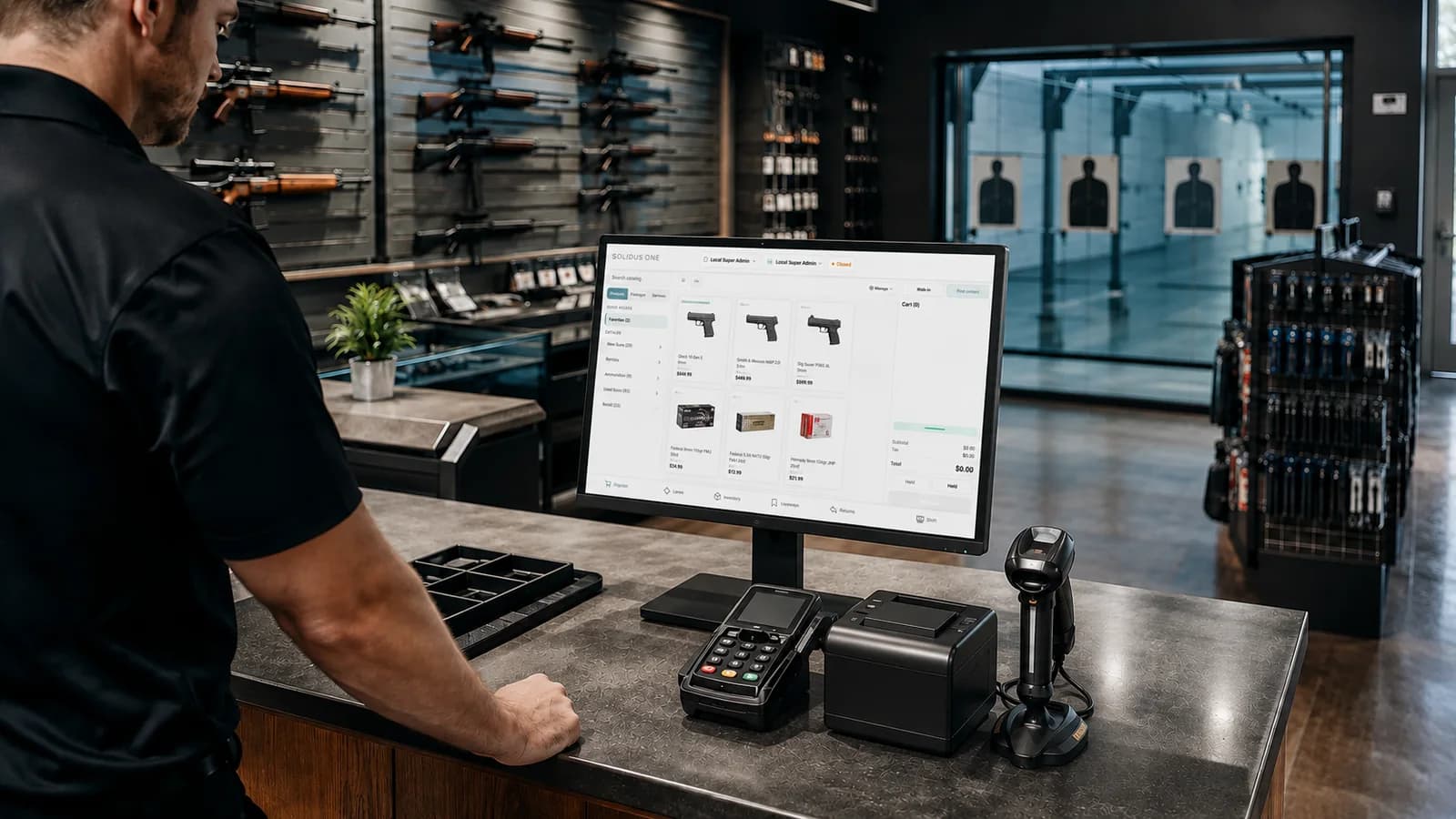
Payment processing is not a background detail for a gun range. It has to work at the retail counter, during a lane rush, on the online storefront, and when a member's recurring payment comes due. The processor also has to understand the business it is underwriting.
Solidus uses Payroc because that combination matters. Payroc publicly supports firearms businesses and provides payment tools for card-present and online transactions. Solidus connects those payment moments to the range operation: the customer, cart, membership, booking, inventory, and reporting.
The boundary between the two companies should be easy to understand. Solidus runs the operating workflow. Payroc provides the payment processing infrastructure and merchant relationship. Here is what that means in practice.
Payroc publicly supports firearms businesses
Some payment providers restrict or avoid firearms-related merchants. That can leave a range owner trying to explain a lawful, regulated business to a provider that was never prepared to support it.
Payroc takes a direct position. On its firearms industry page, the company describes itself as a gun-friendly payment partner and says it has served the firearms industry since 2003. It also says its U.S.-based team performs diligence in house so it can support firearms merchants over time. Read Payroc's firearms business overview.
That is the main reason for the fit. Solidus is built for indoor ranges, gun stores, training programs, and the workflows around them. A payment provider serving that software should be comfortable with the same market.
Support still depends on underwriting, the merchant agreement, the products a business sells, and applicable law. No software company can promise approval on behalf of a processor. Payroc reviews merchant information and decides whether an account can process transactions.
Counter and online payments belong in one operation
A range may take card payments in several places. A customer buys ammunition at the counter. A family books lane time online. A student pays for a class. A member signs up for recurring billing. An employee later needs to find, refund, or reconcile the transaction.
Payroc says it supports both card-present and ecommerce channels for firearms businesses and can integrate with gun dealer web platforms and POS systems. Solidus uses those capabilities inside its own range and retail workflow.
At the counter, the Solidus web and Android POS send the payment request to a supported Payroc terminal. The terminal handles the card interaction. Solidus receives the result it needs to complete the sale, record the tender, print the receipt, and keep the transaction connected to the customer and cart.
For online or saved-payment use cases, Solidus uses Payroc-hosted payment tools and tokens. That allows the customer to enter sensitive card information in the processor's payment experience while Solidus works with the resulting token and transaction response.
See the Solidus POS workflow for the operating side of that handoff.
What Solidus keeps and what Payroc protects
“Solidus stores no payment information” would be too broad. A useful POS has to retain enough information to identify and reconcile a payment. Solidus may store processor tokens and references, transaction IDs, authorization results, amount, status, card brand, last four digits, and expiration display details where needed for the customer or staff experience.
Those records are different from raw card numbers and security codes. Payroc explains that tokenization replaces payment details with a token and keeps the underlying payment details in its vault. The merchant or connected software can use the token for an approved future transaction without storing the raw account details. Payroc's tokenization guide explains the model.
The practical rule is simple:
- Payroc handles the sensitive card-entry and vaulting layer for supported Solidus payment flows
- Solidus keeps the operating record and the payment references needed to run the business
- A token is still sensitive business data and should be protected, even though it is not a card number
- Staff should never type card numbers into customer notes, support messages, or an improvised form
That distinction is more accurate than a sweeping promise and more useful during a security review.
Merchant onboarding is handled directly through Payroc at launch
For the current Solidus launch process, the merchant application, underwriting conversation, and banking setup are handled directly with Payroc. Range owners provide the required business, ownership, processing, and deposit information through the Payroc-led process rather than an in-app Solidus onboarding form.
Payroc's boarding documentation says a merchant platform includes legal business information, owners, processing accounts, contacts, pricing, and terminal orders. Payroc reviews the submitted information before approving a processing account. The official boarding guide describes those resources and the review.
This direct setup keeps responsibilities clear. Payroc can answer underwriting, funding, pricing, equipment, and merchant-account questions. Solidus can focus on connecting the approved processing account and terminals to the POS, storefront, memberships, and reporting.
The exact commercial terms come from the Payroc merchant agreement. Owners should review pricing, funding timing, chargeback procedures, terminal costs, contract term, cancellation terms, and support contacts before signing.
PCI responsibility does not disappear
Using hosted fields, tokenization, and supported terminals can reduce the amount of raw card data that reaches a merchant's software environment. It does not make every party automatically PCI compliant.
Payroc's PCI guide says businesses that accept cards must comply with PCI DSS. It also explains that merchants may need to complete a Self-Assessment Questionnaire and, depending on their environment, vulnerability scanning or other validation. Review Payroc's current PCI compliance guide.
A range still controls important parts of the environment:
- Who can use the POS and merchant portal
- Whether terminals are inspected and physically secured
- How staff handle receipts and customer information
- Which computers and networks reach payment systems
- Whether required PCI questionnaires and scans are completed
- How suspicious activity, chargebacks, and lost devices are reported
Ask Payroc which questionnaire applies to the configured payment channels. Keep the answer with your implementation records. If the setup changes, such as adding ecommerce, a different terminal, or another location, review the scope again.
A professional payment experience is operational
Customers notice payment quality when something goes wrong. A professional setup provides a clear amount, a familiar terminal flow, a usable receipt, and a definite result. Staff should know whether a payment was approved, declined, canceled, or still uncertain before they try again.
Solidus connects the result to the sale so the employee can keep working from the same transaction. The system also retains the references needed for support and reconciliation. If a terminal response is unclear, staff should follow the documented recovery path instead of starting a second charge from memory.
This is one reason processor support matters. Payroc offers merchant and device support channels, while Solidus supports the POS workflow and integration. Before launch, write down which team owns terminal hardware, processing-account questions, POS behavior, refunds, and reconciliation issues.
Test the real payment path before opening day
Do not stop at one approved test card. Run the situations the counter will see:
- A normal retail card sale
- A lane visit with rentals and other charges
- A declined payment and a safe retry
- A canceled terminal prompt
- A receipt reprint
- A refund under your store policy
- An online booking
- A membership signup and the next billing event
- End-of-day comparison between Solidus and the processor record
Confirm what the employee sees in each case. The language should make the next step obvious. Record the terminal model, merchant support contact, Solidus support path, and the person at the range who owns reconciliation.
Why the partnership choice matters
Solidus could connect range operations to a general-purpose processor and leave each merchant to discover whether the relationship fits. We chose Payroc because it publicly supports firearms businesses and offers the card-present, ecommerce, tokenization, and merchant-service capabilities the product needs.
That does not remove underwriting, PCI duties, or careful implementation. It gives the range a payment provider that understands the market and a POS built around the rest of the visit.
If you want to see the counter and online payment paths inside Solidus, book a demo. We can walk through a sale, terminal handoff, customer record, membership, and reconciliation without pretending the processor and the software have the same job.